“Amazing Grace” Series

“The Star of the Show” – Philippians 2:3-5

Philippians 2:3-5

“Do nothing from selfish ambition or conceit, but in humility count others more significant than yourselves. Let each of you look not only to his own interests but also to the interests of others. Have this mind among yourselves, which is yours in Christ Jesus”

 Paul’s admonition here falls into the category of ‘easier said than done.’ It’s our natural default to always think of and look out for ourselves – our preferences, our aspirations, our reputation. The movie we play in our head usually has us as the hero or the victim, but always the star of the show. Other people are simply supporting staff, extras coming into and out of scenes that highlight OUR story. But Paul is saying here to give others equal billing, or worse, put them ahead of ourselves?
 
If you’re like me, you might be thinking, “Impossible! I can be nice to others, but consider them as more significant than me? That’s a tall order.” But this isn’t impossible, it’s just uncomfortable. It’s part of dying to ourselves, which is part of being a disciple. This death to self doesn’t just allow us to follow Christ, it also creates an ensemble cast that points to Him as the TRUE star of the show.
 
While using the HEAR method (see below) consider the following questions:
  • Are there some people that you find it particularly difficult to count as “more significant than you?”
  • How might you look to the interest of others today?  

Highlight – what words or phrases jump out at you?
Explain – what does the passage mean?
Apply – how does the passage intersect with your life today?
Respond – how is God leading you to respond?

Today’s post is by Jon Price, Associate Pastor

Photo by Oscar Keys on Unsplash

“The Star of the Show” – Philippians 2:3-5 Read More »

“Worth the Price” – Philippians 2:1-2

Philippians 2:1-2

“So if there is any encouragement in Christ, any comfort from love, any participation in the Spirit, any affection and sympathy, complete my joy by being of the same mind, having the same love, being in full accord and one mind.” 

As Paul writes to the believers in Philippi, it seems as if he’s giving them a checklist of items, that once fully checked off, they can move on to “completing his joy.” But Paul is actually the one checking off the list. He is using a rhetorical conditional statement to refer to items they already knew to be true. Paul was reminding them of all that Christian community held for the believer. He was emphasizing how important Christian fellowship was to their health, growth and effectiveness. They needed to guard and protect this fellowship by being of one mind. 

Maintaining unity among a diverse group of people can be difficult. But unity doesn’t mean uniformity. We all have our opinions, preferences and agendas – it’s only human. However, these things take a back seat to the mission of the gospel. In times where we need to humbly submit our own desires for the church to be in full accord, Paul is saying the prize is worth the price.  

While using the HEAR method (see below) consider the following questions:

  • What are the benefits that Paul lists of being in Christian fellowship? (hint: the first one is “encouragement in Christ”) List them in your journal or in the comment section below. 
  • As you look at that list, can you think of instances where you experienced these firsthand among a fellowship of believers?
  • Which of these benefits do you need most right now?  
  • How might you create these elements among the fellowship today? 

Highlight – what words or phrases jump out at you?

Explain – what does the passage mean?

Apply – how does the passage intersect with your life today?

Respond – how is God leading you to respond?

Today’s post is by Jon Price, Associate Pastor



“Worth the Price” – Philippians 2:1-2 Read More »

“Peter, Paul and Melee” – Galatians 2:1-14

Galatians 2:1-14
 
“Then after fourteen years, I went up again to Jerusalem with Barnabas, taking Titus along with me. I went up because of a revelation and set before them (though privately before those who seemed influential) the gospel that I proclaim among the Gentiles, in order to make sure I was not running or had not run in vain. But even Titus, who was with me, was not forced to be circumcised, though he was a Greek. Yet because of false brothers secretly brought in—who slipped in to spy out our freedom that we have in Christ Jesus, so that they might bring us into slavery— to them we did not yield in submission even for a moment, so that the truth of the gospel might be preserved for you. And from those who seemed to be influential (what they were makes no difference to me; God shows no partiality)—those, I say, who seemed influential added nothing to me. On the contrary, when they saw that I had been entrusted with the gospel to the uncircumcised, just as Peter had been entrusted with the gospel to the circumcised (for he who worked through Peter for his apostolic ministry to the circumcised worked also through me for mine to the Gentiles), and when James and Cephas and John, who seemed to be pillars, perceived the grace that was given to me, they gave the right hand of fellowship to Barnabas and me, that we should go to the Gentiles and they to the circumcised. Only, they asked us to remember the poor, the very thing I was eager to do.
 
But when Cephas came to Antioch, I opposed him to his face, because he stood condemned. For before certain men came from James, he was eating with the Gentiles; but when they came he drew back and separated himself, fearing the circumcision party. And the rest of the Jews acted hypocritically along with him so that even Barnabas was led astray by their hypocrisy. But when I saw that their conduct was not in step with the truth of the gospel, I said to Cephas before them all, “If you, though a Jew, live like a Gentile and not like a Jew, how can you force the Gentiles to live like Jews?”
 

Paul shared his interaction with the church leaders in Jerusalem after years of ministry to the gentiles. He brought with him several proteges to show the results of his labor and evidence of God’s movement among non-Jewish believers.

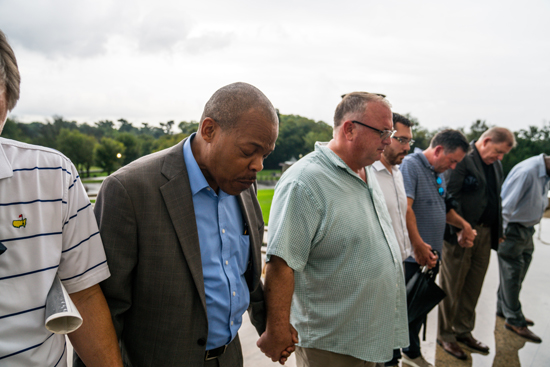
Apparently, there was still a little work to do. Some from the old guard thought that in order for the gentiles to be good Christians, they first needed to be good Jews by following certain old covenant practices, such as circumcision. Paul even had to confront Peter (Cephas), the leader of the church for waffling on his treatment of gentile Christians as equals. When he was solely with the gentiles, he would share a meal with them without issue, but when accompanied by his Jewish peers, Peter separated himself from them. Paul saw that their conduct was not “in step with the truth of the gospel,” so for the sake of unity in the church, he confronted Peter on his hypocrisy and they resolved the issue.

While using the HEAR method (see below) consider the following questions:

  • Are there those in the faith that you are tempted to view as beneath you because they hold different opinions on traditions and practices that might (or might not) be important to you?
  • What are some preferences you might hold that are not “in step with the truth of the gospel?”

Highlight – what words or phrases jump out at you?

Explain – what does the passage mean?

Apply – how does the passage intersect with your life today?

Respond – how is God leading you to respond?

Today’s post is by Jon Price, Associate Pastor
 

“Peter, Paul and Melee” – Galatians 2:1-14 Read More »

“What will it take?” – Galatians 1:15-16

Galatians 1:15-16

“But when he who had set me apart before I was born, and who called me by his grace, was pleased to reveal his Son to me, in order that I might preach him among the Gentiles, I did not immediately consult with anyone;”

We can always find reasons to hesitate. We can always point to someone who would do better than us, or find reasons why we’re not capable or qualified. Paul certainly could have balked at a ministry to the gentiles by pointing to his past. Everyone else was!

Instead, Paul clung to his convictions. He firmly believed that God had…

    set him apart from before his birth,

        called him by His grace,

            and revealed His Son to him.

These three touchstones moved Paul to action. He didn’t need further convincing or endorsement.

What would it take to move you to action? What would it take to convince you – to put wind to your sails? We can’t wait for all the stars to align, but we can look at the constellation of our gifting, passion, and experiences and take the next best step in faith.

While using the HEAR method (see below) consider the following questions:

  • What are the excuses you’re clinging to, or the approval you’re waiting for that’s keeping you from moving forward? 
  • How has God blessed, equipped, or confirmed to you that might lead you toward a direction of action? 
Highlight – what words or phrases jump out at you? 
Explain – what does the passage mean? 
Apply – how does the passage intersect with your life today? 
Respond – how is God leading you to respond? 
Today’s post is by Jon Price, Associate Pastor


“What will it take?” – Galatians 1:15-16 Read More »